
Iran Names Mojtaba Khamenei Supreme Leader After Rare Leadership Transition
- karvaan25
- Mar 9
- 4 min read

Tehran
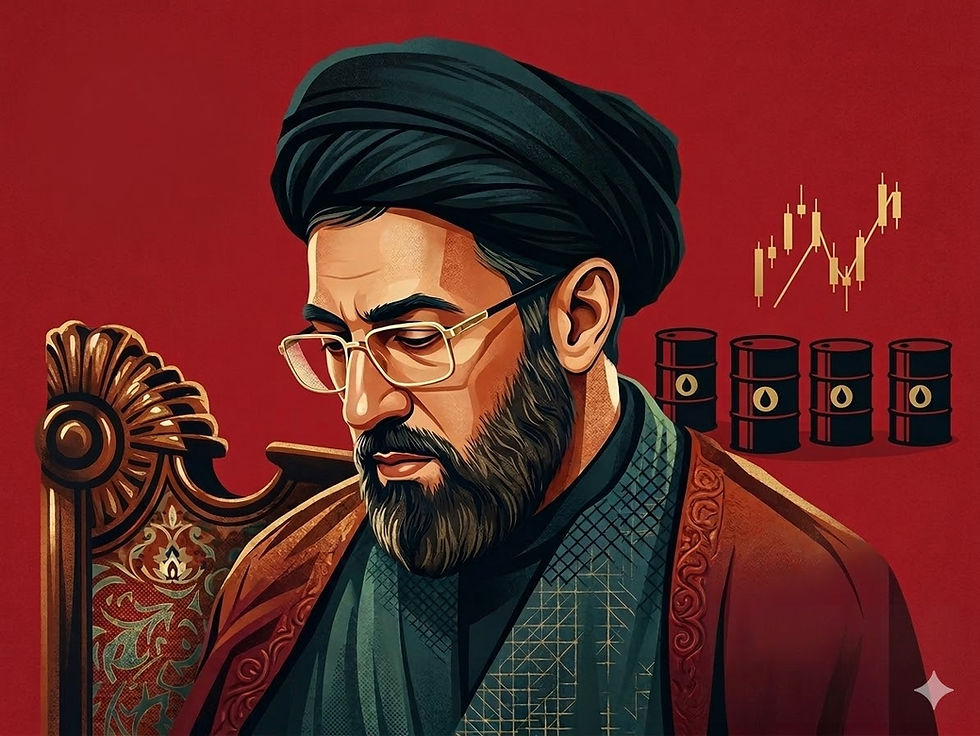
Mojtaba Khamenei Supreme Leader: Iran’s clerical establishment has moved to secure a new leadership after the death of Supreme Leader Ayatollah Ali Khamenei, setting in motion a rare transition at the apex of the Islamic Republic’s political system.
Within days of the leadership vacancy, members of the Assembly of Experts, the powerful body responsible for appointing Iran’s supreme leader, convened in Tehran for emergency deliberations. The assembly, composed of 88 senior clerics elected to eight year terms, holds the constitutional authority to select and supervise the country’s highest religious and political authority.
Following intense consultations behind closed doors, the assembly announced that Mojtaba Khamenei, a cleric long associated with the conservative core of the Iranian establishment and the son of the late leader, had been selected to assume the position.
Senior cleric Ahmad Khatami, a member of the Assembly of Experts, said the choice reflected the need for stability at a moment of uncertainty. “The Islamic Republic must preserve the principles of the revolution and maintain unity in difficult circumstances,” he said in remarks carried by Iranian state media.
The position Mojtaba Khamenei now occupies is the most powerful office in Iran. The supreme leader stands above the elected president and parliament and exercises decisive influence over the country’s political, military and judicial institutions. The office includes command of the armed forces, authority over the judiciary and the power to appoint key figures in state institutions.
The role was established after the 1979 Islamic Revolution under the doctrine of velayat e faqih, which grants ultimate authority to an Islamic jurist responsible for guiding the state.
Since the revolution, only two men had previously served as supreme leader. Ayatollah Ruhollah Khomeini led the country until his death in 1989. The Assembly of Experts then selected Ali Khamenei, who remained in power for more than three decades and oversaw a period marked by regional confrontation, sanctions and internal political struggles.
Under Iran’s constitution, the Assembly of Experts must convene to select a successor whenever the office becomes vacant. The process typically involves consultations among senior clerics and negotiations involving influential institutions such as the Islamic Revolutionary Guard Corps, which has emerged as a major political and military force in the country.
The deliberations of the assembly are conducted in secrecy, and the internal dynamics that shape the final decision rarely become public.
Mojtaba Khamenei has long been regarded as a figure with influence inside Iran’s conservative political networks, despite never holding an elected office.
Born in Tehran in 1969, he studied Islamic jurisprudence in the seminaries of Qom, the centre of Shiite religious learning in Iran. Over the years he developed close ties with clerical figures and with commanders of the Revolutionary Guards, relationships that analysts say strengthened his position within the ruling establishment.
During the political unrest that followed Iran’s disputed presidential election in 2009, reformist politicians accused him of playing an influential role behind the scenes in managing the state’s response to the protests.
Mohammad Ali Abtahi, a reformist politician and former vice president under Mohammad Khatami, once described Mojtaba Khamenei as “a man whose influence inside the system exceeded his public profile.”
For many observers the most striking aspect of the transition is the fact that power has effectively remained within the same family. The Islamic Republic was founded in opposition to the monarchy that ruled Iran before the 1979 revolution, and its leaders have long rejected the principle of hereditary rule.
Analysts say the decision reflects the dominance of conservative institutions within Iran’s political structure.
Ali Vaez, the Iran project director at the International Crisis Group, said the leadership had opted for continuity during a period of heightened regional tension. “The system is designed to prioritise stability. In moments of crisis the establishment tends to rally around figures who are deeply embedded in its networks of power,” he said.
Others point to the growing influence of the Revolutionary Guards in Iran’s political life.
Saeid Golkar, an expert on Iranian politics at the University of Tennessee at Chattanooga, said the support of powerful institutions often plays a decisive role in leadership transitions. “The supreme leader must be someone who can command the loyalty of the security establishment and maintain cohesion among the country’s major power centres,” he said.
Iran’s leadership change comes at a time when the country faces a range of internal and external pressures. Years of economic sanctions have strained the economy, while regional tensions and domestic political divisions continue to shape the country’s political landscape.
Hossein Mousavian, a former Iranian diplomat and nuclear negotiator, said the new leader would inherit a complex strategic environment. “The next supreme leader will have to balance internal expectations with a very challenging international context,” he said.
Leadership transitions in the Islamic Republic are rare. The last time Iran experienced such a moment was in 1989 following the death of Ayatollah Khomeini. At that time the Assembly of Experts selected Ali Khamenei, who was then serving as president, after intense debate within the clerical establishment.
More than three decades later, Iran has again witnessed a transfer of authority at the very top of its political system.
Whether Mojtaba Khamenei will be able to consolidate authority in the same way his father did remains uncertain. Much will depend on his ability to navigate Iran’s complex network of clerical, military and political institutions.
For now, the clerical establishment has made its choice, ushering in a new phase in the history of the Islamic Republic.