
Karvaan India's Spotlight: From Geneva Talks to Threats of War: Iran Tells U.S. It Is Prepared to Fight
- Karvaan Spotlight Desk

- Feb 23
- 6 min read
Updated: Feb 24
Listen to this episode of our podcast on Spotify
https://bit.ly/3ZP5fqK
Video Explainer
The Lead
From Geneva Talks to Threats of War | Iran–United States Tensions Escalate as Military Signalling Meets Economic Risk
The confrontation between Iran and the United States has entered a precarious phase. There is still no declared war, but the temperature has risen sharply.
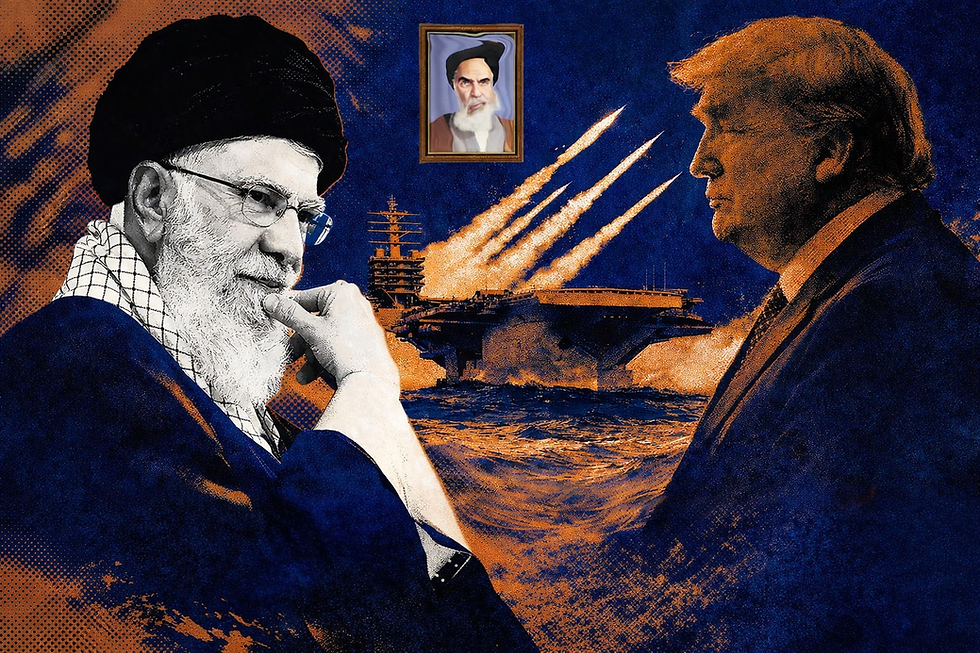
Iran’s Supreme Leader Ayatollah Ali Khamenei has warned that American warships in the Gulf “can be sunk” if conflict begins. Senior commanders of the Islamic Revolutionary Guard Corps have stated that Iran is prepared for any level of confrontation.
At the same time, Washington has reinforced its naval and air presence in the region, maintaining that military options remain available if nuclear negotiations fail.
Diplomacy continues in Geneva this week. Yet it now unfolds in parallel with visible preparations for escalation. The risk is no longer theoretical. It is strategic, economic and global.
The Context | How We Got Here
The roots of the crisis lie in the collapse of the earlier nuclear arrangement and the reimposition of U.S. sanctions. Since sanctions were tightened, Iran’s oil exports have fluctuated sharply, at times falling below 500,000 barrels per day during peak pressure periods, compared to more than 2.5 million barrels per day before sanctions were restored. Though exports later partially recovered through alternative channels, Iran’s economy remains constrained.
Inflation inside Iran has hovered around 40 percent in recent years. The currency has depreciated significantly against the dollar. Sanctions have restricted access to global banking systems and foreign investment.
From Washington’s perspective, economic pressure is leverage. From Tehran’s perspective, it is collective punishment.
Under President Donald Trump, the United States has signalled a return to maximum pressure. Additional naval groups, aircraft and missile defence systems have been positioned in and around the Gulf. Officials describe this as deterrence designed to prevent further nuclear escalation.
Iran’s Foreign Minister Abbas Araghchi has indicated that talks have shown constructive elements but insists that sanctions relief must accompany any agreement. Negotiation under military threat, Tehran argues, cannot be genuine diplomacy.
The Strategic Frame
Iran’s threat to sink U.S. ships must be understood within its asymmetric doctrine. Tehran lacks parity with American conventional power. Instead, it has invested in anti ship ballistic missiles, drones, naval mines and fast attack craft designed to operate in confined waters such as the Strait of Hormuz.
The Strait of Hormuz is one of the most critical economic chokepoints in the world. Roughly 17 to 20 million barrels of oil per day pass through it. That accounts for nearly one fifth of global petroleum consumption. Around one third of global seaborne oil trade moves through this corridor.
Liquefied natural gas shipments from Qatar, which supplies close to 20 percent of global LNG exports, also transit this route.
Even temporary disruption would have immediate economic consequences.
The United States retains overwhelming military capacity. But overwhelming capacity does not eliminate vulnerability in narrow maritime space. A single successful strike or mining incident could cause insurance rates for shipping to surge, raising energy prices globally.
Thus, deterrence in this theatre is not only about military credibility. It is about economic leverage.
The Regional Question
West Asia’s energy infrastructure forms the backbone of global commodity markets. Saudi Arabia, the United Arab Emirates, Iraq and Kuwait rely heavily on Gulf export routes. An escalation between Washington and Tehran would place ports, refineries and pipelines at risk.
Oil markets have already reacted to heightened rhetoric. Even modest supply fears can push prices upward by several dollars per barrel within days. A sustained disruption could drive prices sharply higher, feeding inflation worldwide.
For India, which imports more than 80 percent of its crude oil needs, a ten dollar increase in global crude prices can significantly widen the current account deficit and strain fiscal balances. Similar vulnerabilities exist for China, Japan and European economies.
Global inflation remains sensitive after recent supply chain disruptions. Energy price spikes would cascade into transport, food and manufacturing costs.
Financial markets also price geopolitical risk. Equity indices tend to retreat during Gulf tensions. Safe haven assets such as gold often strengthen. Currency volatility increases in emerging markets exposed to energy imports.
Thus, this confrontation is not confined to military calculus. It is deeply embedded in global economic stability.
Between the Lines | The Accumulating Risk
The present danger lies in simultaneity. Negotiations proceed even as fleets patrol strategic waters.
Iran signals readiness to target ships. The United States signals readiness to strike nuclear infrastructure. Each side claims deterrence. Yet deterrence depends on controlled escalation.
A miscalculated incident in the Strait of Hormuz could interrupt 20 percent of global oil flows overnight. Even a temporary disruption of two to three million barrels per day would jolt markets. Analysts estimate that a severe closure scenario could push oil prices well above 120 dollars per barrel in the short term.
Energy shocks translate quickly into political stress. Governments facing rising fuel prices encounter domestic backlash. Currency depreciation and inflation amplify social pressures.
In this sense, brinkmanship carries macroeconomic consequences far beyond the Gulf.
The Global Lens
The Iran–United States standoff unfolds within a broader multipolar environment.
Russia and China have expanded strategic and economic engagement with Iran. China remains one of Iran’s largest oil buyers. Any escalation that constrains Iranian exports further would complicate global supply balances and potentially increase reliance on alternative producers.
The United States, already managing commitments in Europe and the Indo Pacific, would face strategic stretch in the event of sustained Gulf operations. Allies would need reassurance. Adversaries would watch for signs of overextension.
Global energy markets today are more interconnected than during earlier Gulf crises. Supply chain fragility means that energy price volatility feeds directly into food security and industrial output.
International institutions urge de escalation, aware that a regional war would ripple through trade routes, insurance markets and global shipping networks.
Moreover, the Global South increasingly views sanctions regimes with scepticism. Prolonged economic restrictions often hurt civilian populations more than political elites. That perception shapes diplomatic alignments and voting patterns in multilateral forums.
The crisis therefore intersects with larger questions about the use of sanctions as instruments of foreign policy and the sustainability of coercive economic statecraft.
What Comes Next
The Geneva talks represent an immediate turning point. A phased framework combining sanctions relief with enforceable nuclear limits could reduce tension and stabilise markets.
If talks collapse, escalation pathways widen. Additional deployments, expanded enrichment and heightened rhetoric would deepen uncertainty.
Markets will respond instantly. Governments will recalibrate energy procurement strategies. Shipping insurers will adjust premiums.
In geopolitical crises, economic indicators often move before political agreements do.
Voices | Who Said What
Ayatollah Ali Khamenei warned that American ships are not beyond reach and that Iran will defend itself decisively.
Revolutionary Guard commanders have emphasised that Iran’s missile and naval capabilities are designed precisely for deterrence in the Gulf.
President Donald Trump has stated that military options remain available while maintaining preference for a negotiated settlement that curtails Iran’s nuclear expansion.
Foreign Minister Abbas Araghchi has reiterated that Iran seeks a balanced agreement that includes sanctions relief and recognition of its sovereign rights.
Editor’s Lens | Karvaan’s Spotlight
This crisis is as much about economics as it is about missiles.
American strategy relies heavily on sanctions backed by military visibility. The theory is straightforward. Economic pressure constrains resources. Military presence reinforces seriousness. Together they produce compliance.
Yet decades of sanctions have not collapsed Iran’s state structure. Instead, they have reshaped its economy, redirected trade and entrenched narratives of resistance. Inflation and currency decline hurt ordinary citizens. Political elites adapt.
The reliance on coercive economic tools carries global side effects. When sanctions target major energy producers, they tighten supply margins worldwide. The burden of volatility spreads to importing nations, many of whom had no role in the dispute.
Iran’s threats to sink ships are calibrated signals of asymmetrical leverage. They communicate that economic chokepoints can offset military asymmetry. In a globalised economy, disruption is power.
The United States frames its posture as necessary to prevent nuclear escalation. Yet pressure without credible diplomatic off ramps risks perpetual crisis. When negotiations occur alongside carrier groups, trust is structurally thin.
The larger question is whether coercive leverage still yields sustainable
agreements in a multipolar world. If pressure consistently hardens positions, it may generate resistance rather than reform.
War in the Gulf would not only be a military event. It would be an energy shock, an inflationary trigger and a stress test for global trade.
In geopolitics, the cost of escalation is rarely confined to the battlefield. It is measured in fuel prices, currency charts and household budgets across continents.
Restraint, therefore, is not merely a diplomatic virtue. It is an economic necessity.
The coming days will reveal whether strategic prudence prevails over escalation in one of the world’s most economically sensitive corridors.