
KARVAAN INDIA SPOTLIGHT : How Iran Has Responded So Far, What Happened Today, and What It Means
- Karvaan Spotlight Desk

- Mar 2
- 7 min read
Updated: Mar 2

The Lead
How Iran Has Responded So Far : Several days after the unprecedented strike inside Tehran eliminated Iran’s Supreme Leader and key members of its senior military command, the initial shock has hardened into something more volatile: a sustained and carefully structured Iranian retaliation unfolding across multiple theatres.
What was framed as a decisive decapitation has instead triggered a rolling campaign. This has not been a single dramatic counter blow. It has been a rolling campaign of ballistic missile salvos, long range drones, cruise projectiles, cyber signalling and coordinated proxy activity stretching from southern Lebanon to the northern Gulf. Israeli towns have been struck repeatedly. U.S. forward operating bases in Iraq, Kuwait, Qatar and Bahrain have absorbed hits. Gulf energy infrastructure has been threatened and, in at least one case, forced into precautionary shutdown. Airspace closures, maritime risk alerts and spiking crude prices reflect a reality that goes beyond battlefield imagery.
The decapitation was meant to compress the conflict. Instead, it stretched it.
Today’s developments, including multiple reported U.S. combat aircraft crashes over Kuwaiti airspace, renewed missile penetrations into Israeli urban zones, and the drone incident that halted operations at Saudi Arabia’s Ras Tanura refinery, underscore a broader truth: Iran has chosen escalation across military and economic domains rather than symbolic retaliation. The conflict has shifted from a decapitation strike to a test of endurance.
I. The Architecture of Retaliation
Iran’s retaliation reveals a deliberate architecture. It can be understood across three interlocking tracks.
1. Saturation Pressure on Israel
Iran has used ballistic missiles, cruise systems and long range UAVs to repeatedly strike Israeli population centres and infrastructure nodes. The objective appears twofold: force Israel’s air defence network into continuous high intensity interception cycles, and allow select penetrations to generate psychological and political impact.
Even where intercept rates remain high, each salvo imposes cost, consumes interceptors and disrupts civilian life. Interception is not immunity. It buys time, not invulnerability.
Urban impacts around towns such as Beit Shemesh have caused structural damage to residential buildings, roadways and municipal facilities. The cumulative strain is measurable. Iran’s aim appears less about decisive destruction and more about exhausting resilience.
2. Calibrated Degradation of U.S. Military Posture
Iran and Iran aligned militias have targeted American forward facilities across Iraq and the Gulf. Sites such as Ain al Asad Air Base in Iraq have shown visible blast damage to aircraft shelters, fuel storage zones and logistical compounds in open source satellite imagery. Kuwait and Qatar reported interceptions near or above facilities hosting U.S. forces.
CENTCOM confirmed American fatalities and injuries, a watershed moment that shifts Washington from punitive operator to casualty bearing combatant.
The reported crashes of multiple U.S. military aircraft over Kuwaiti airspace have intensified scrutiny. Video of at least one fighter jet descending in flames circulated widely, showing pilot ejection. Official tallies remain cautious. Terms such as several are being used, and precise aircraft counts are still being reconciled between coalition and host nation sources. Claims circulating on social media regarding specific numbers of F 15 losses remain unconfirmed by consolidated official statements.
Whether from hostile fire, operational strain or defensive manoeuvres during high tempo sorties, aircraft losses represent escalation. Combat airframes are strategic assets. Even temporary grounding alters regional air dominance calculations. High value losses under active engagement change tempo, posture and political signalling.
3. Economic Internationalisation of the Conflict
By striking or threatening Gulf energy nodes and shipping corridors, Iran has widened the cost beyond immediate adversaries.
The drone activity that triggered an emergency shutdown at Ras Tanura, a refinery processing roughly 550,000 barrels per day, immediately reverberated through oil markets. Maritime insurers raised risk premiums. Tanker routes through the Strait of Hormuz were reassessed.
Energy markets react faster than diplomacy. Even temporary risk in Hormuz prices into every barrel.
This was not accidental spillover. It was strategic signalling. Together, these tracks form a coherent retaliation doctrine: stretch defences, impose visible cost and globalise the consequences.
II. From Initial Salvos to Today’s Escalation

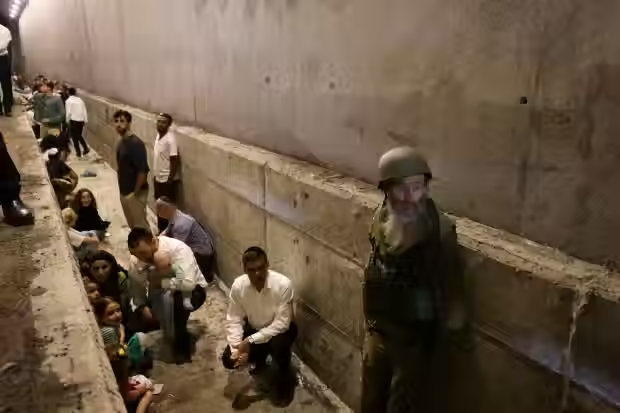
In the first 24 hours following the strike on Tehran, Iran launched concentrated missile waves into Israeli airspace. Sirens and shelter activations rippled across central Israel. Some projectiles penetrated defence layers.
Within 48 hours, the theatre expanded. Drone and missile activity was reported across Iraq and the Gulf. U.S. installations sustained damage. Video and satellite imagery documented fires and structural impacts at base infrastructure. American officials confirmed fatalities and serious injuries among service members.
Today marked a new intensity spike. Kuwaiti authorities reported multiple U.S. military aircraft crashing within or near Kuwaiti airspace amid sustained aerial operations and air defence engagements. Simultaneously, Saudi Arabia confirmed that drone activity near Ras Tanura prompted a precautionary refinery shutdown. Hezbollah rocket fire into northern Israel triggered retaliatory Israeli strikes on southern Lebanon and parts of Beirut’s southern suburbs.
The campaign is no longer geographically confined.
III. The Damage Profile So Far
Israeli Urban and Civil Infrastructure

Repeated missile penetrations have caused structural damage to residential buildings, roadways and municipal facilities. While Israel’s layered air defence architecture remains operational and intercept rates are significant, the cumulative strain is reshaping civilian routines and public psychology. Iran’s apparent calculation is that deterrence is psychological as much as material.
U.S. Forward Bases and Assets
Blast scarring near aircraft hangars, burned support vehicles and damage to fuel depots at multiple U.S. facilities demonstrate the vulnerability of forward deployed assets. Even limited infrastructure damage can degrade sortie rates, delay maintenance cycles and complicate munitions storage protocols. Sustained tempo increases the likelihood of operational accidents, a risk amplified during complex air defence environments.

Gulf Economic Nodes
Ras Tanura’s temporary shutdown underscores the fragility of energy chokepoints during conflict. The Strait of Hormuz remains operational but under elevated risk. Shipping advisories and rerouted vessels signal commercial recalibration that may outlast the immediate exchanges.
IV. The Fog of Conflict
Aircraft loss counts vary. Damage assessments continue to evolve. Attribution remains complex. The information war runs parallel to the kinetic one. Claims are amplified for morale, deterrence and narrative advantage. Responsible analysis demands separation between confirmed reporting and circulating speculation.
The battlefield is noisy. The narrative space is louder.
V. Voices from the Perimeter
To understand the scale and meaning of this retaliation, it is useful to listen to language emerging from different capitals and strategic circles. The rhetoric reveals how the confrontation is being interpreted.
“Iran’s attacks and violation of sovereignty of a number of countries in the region are inexcusable. Iran must refrain from indiscriminate military strikes.”
In Tehran, the language has been equally direct. “Iran has no option but to respond after Khamenei’s killing,” an Iranian official declared, warning that the United States had crossed “a very dangerous red line” with the strike on the capital.
In Jerusalem, Prime Minister Benjamin Netanyahu stated that military action against Iran “will only intensify,” and publicly thanked the United States for backing Israel’s long standing security goals.
From Washington, the domestic dimension has surfaced clearly. The U.S. military announced its first casualties in the Iran operation, and President Trump indicated he was willing to talk to Iran even as fighting continues, underscoring the political complexity of managing escalation while avoiding entanglement.
Global reaction has also included calls for civilian protection. “Bombs and missiles are not the way to resolve differences but only result in death, destruction and human misery,” the United Nations human rights chief said in a statement decrying military strikes by all sides.
Taken together, these voices underline a central reality: this is no longer a contained retaliation cycle. It is a regional stress event with military, economic and political layers interacting simultaneously.
Listen to the podcast, generated with AI’s assistance, for this Spotlight.
https://bit.ly/4ldwsNB
VI. Strategic Analysis: Restoration or Escalation?
Iran’s retaliation reflects a calculated blend of deterrence restoration and escalation control. By striking Israeli towns, Tehran demonstrates that decapitation strikes carry consequences. By targeting U.S. bases, it signals that American forward presence entails vulnerability. By disrupting energy nodes, it internationalises the cost of continued conflict.
Yet Iran has stopped short of actions that would almost certainly trigger overwhelming escalation, such as sustained mass casualty strikes on Gulf capitals or attacks beyond the regional theatre. The retaliation thus appears calibrated to hurt but not yet to trigger total war.
However, calibration collides with chaos. Aircraft crashes, interceptor miscalculations and proxy escalations introduce unpredictable variables. A single misinterpreted strike could widen the conflict dramatically.
VII. India’s Stake: Energy, Diaspora, Diplomacy
For India, the implications are immediate. Energy security sits at the forefront. Even temporary disruptions in Saudi refining or Strait of Hormuz traffic tighten crude availability. Price volatility translates into inflationary pressure at home.
Airspace disruptions across the Gulf affect connectivity for millions of Indian expatriates. Evacuation planning, flight suspensions and embassy advisories become urgent policy considerations.
Diplomatically, New Delhi faces a balancing act: maintain strategic ties with Israel, manage energy dependence on Gulf states and sustain evolving engagement with the United States. A widening regional war complicates that equilibrium.
Watch the video explainer for this Spotlight, generated with AI’s assistance.
VIII. Karvaan Editorial Lens
Decapitation strikes are often presented as decisive acts, surgical interventions that reset geopolitical equations. History shows that removing leadership rarely collapses systems cleanly. It often hardens them.
Iran’s response so far reveals a regime unwilling to absorb humiliation quietly. It has chosen visible retaliation, structured to impose layered cost. Whether this restores deterrence or accelerates escalation depends not only on Tehran but on Washington, Tel Aviv and Gulf capitals.
The deeper lesson is structural. West Asia’s security architecture rests on deterrence balances that are fragile and interdependent. When one pillar is violently removed, the shock reverberates through airspace corridors, oil markets and civilian neighbourhoods.
The aircraft crashes in Kuwaiti skies, the fires at refinery complexes and the sirens in Israeli towns are not isolated events. They are manifestations of a regional system under stress.
Several days ago, the strike in Tehran was presented as decisive.
It now appears catalytic.
The question is no longer whether Tehran has retaliated. It is whether the regional order can withstand sustained escalation without fracturing under its own accumulated strain.
Understand the Spotlight through Karvaan India’s slide deck. Download now.