
What the Financial Times Saw in India's Exam Scandal
- Karvaan India Foreign Media Watch

- 18 hours ago
- 4 min read
Updated: 4 hours ago
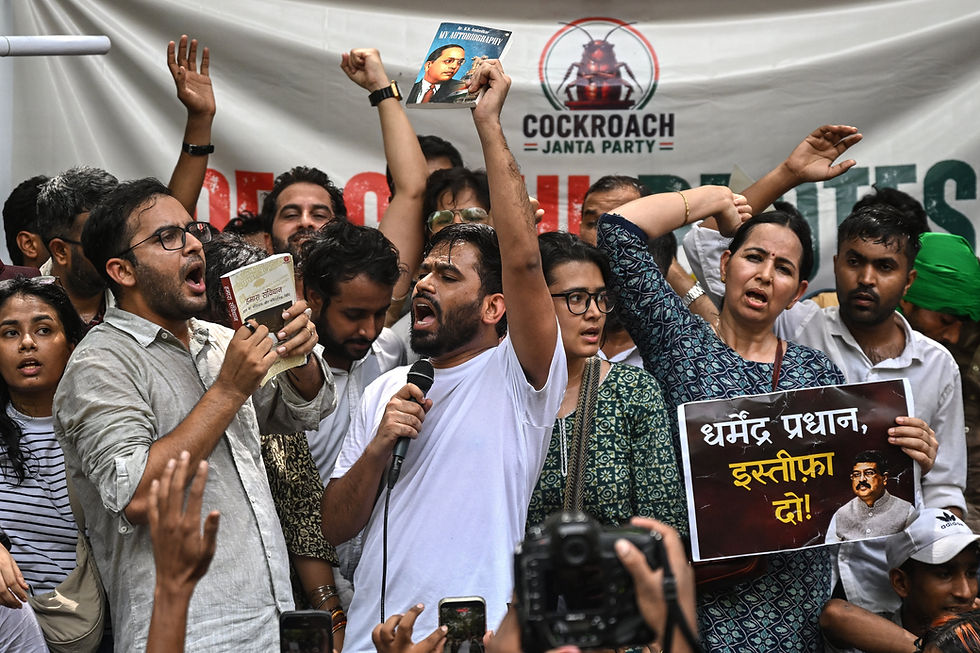
India's Exam Scandal: More than two million young Indians had prepared for the National Eligibility cum Entrance Test last month, many of them having spent years in coaching institutes and exhausted their families' savings to do so. When answers were found to have circulated before the examination, the government cancelled a test that had already been taken. For students such as Manish Kumar of Kota, who had studied twelve hours a day for three years only to find his result voided, the experience has produced a very particular kind of anguish — not the anguish of failure, but of a system that withdrew the very terms on which they had agreed to compete.
The FT's report, filed from Kota in Rajasthan, captures this moment with unusual care. The piece does not reduce the scandal to a political verdict on the Modi government, even as it notes the protests and the viral satirical campaign that has emerged around it. Instead, the report stays with the human texture of the crisis.
The students and parents who appear in it are not types. Umesh Chandra, who travelled 800 kilometres from his village in Uttar Pradesh to enrol his seventeen-year-old daughter at the Allen Career Institute, is quoted asking what he might reasonably do now that the paper has been leaked and his savings have been spent. The question is not rhetorical. It is the most pressing practical question facing the families who have committed years and rupees to the public examination system in the belief that it offers a reliable route to security.
That belief has carried enormous weight in Indian social life. Koppillil Radhakrishnan, who headed a government advisory committee on examination reform, is quoted comparing the June re-test to a "real test for those who conduct these tests." The formulation is exact. When a credentialing system breaks down, it does not merely inconvenience individual candidates; it calls into question the social contract on which the system rests.
Families with limited capital, whether financial or otherwise, have historically treated success in public exams as the most dependable mechanism of upward mobility available to them. The NEET paper leak has damaged that mechanism at the precise moment when it is carrying the most weight. India's youth unemployment figures, cited from a March report by Azim Premji University, suggest that nearly forty per cent of graduates aged fifteen to twenty-five are without work. In that context, the competitive examination has come to function less as a filter of merit than as a compressed site of social hope.
The Kota coaching economy has grown up in response to that hope, and the FT's portrait of the city is one of the report's most valuable contributions. Two hundred thousand students arrive in Kota each year from every part of India, submitting themselves to conditions that the report does not sentimentalise. The warden of a boys' hostel mentions that a student threw himself from an upper floor the day before the May examination, and that the facility has already installed devices on its ceiling fans to prevent hangings.
The Allen Career Institute's vice-president, Vijay Soni, says that most students can "handle pressure," but that the leak has caused morale to fall. These are not contradictory positions. The coaching system has developed considerable institutional competence in managing the psychological demands it places on young people. What it could not have prepared students for is a failure that originated not in the examination hall but in the administrative machinery that was meant to protect the integrity of the process.
There is something worth attending to in how the report handles political attribution. It gives Education Minister Dharmendra Pradhan space to respond, and his written statement — that the government has treated the issue with "utmost seriousness and sensitivity" and remains committed to a "transparent, credible and secure examination system" — is reproduced without editorial dismissal.
The Cockroach Janta Party, the satirical online campaign that has attracted twenty-two million social media followers, is treated with similar evenhandedness. Its founder Abhijeet Dipke, based in Boston, is allowed to make his case, and the government's counter-accusation that the campaign has sought followers from Pakistan is also included. The report neither endorses nor ridicules the political exchange; it records it. That restraint is a form of respect for the reader's capacity to judge.
What the piece has done, quietly and well, is to make the examination crisis legible as something larger than a bureaucratic failure. The anger of Manish Kumar, who joined the satirical party to "express my frustration," and the arithmetic of families who have spent their savings on coaching fees, together produce a picture of a generation that has played by the rules of a system that proved less secure than it had appeared. The government may yet restore credibility through the June re-test. Whether it does so will matter considerably to the young people who have already demonstrated, in their journey to Kota and their twelve-hour study days, a willingness to commit to the terms that the state has offered them.