
March 15 Is Anti-Islamophobia Day. Why Is It So Quiet?
- Staff Writer

- Mar 15
- 5 min read
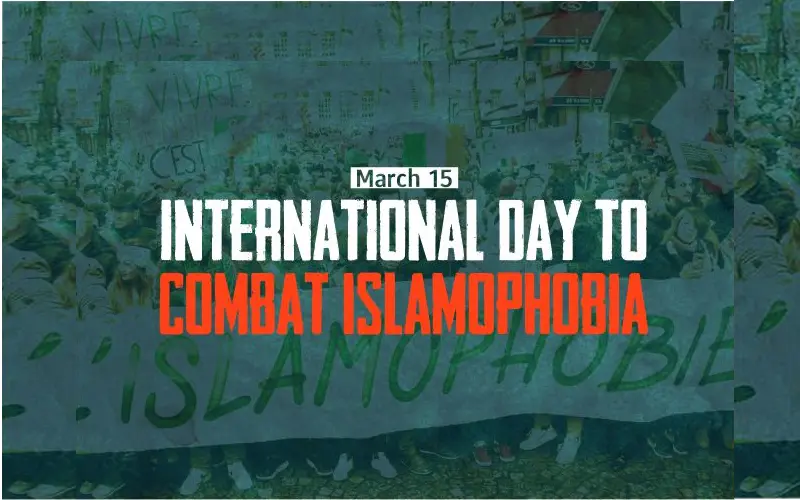
Today, 15 March, the world observes the International Day to Combat Islamophobia, a day recognised by the United Nations to highlight prejudice, discrimination and hostility directed at Muslims across the globe. Yet the day often passes quietly. Unlike many other international observances that generate public campaigns, marches or cultural programmes, Anti-Islamophobia Day is marked mostly through official statements, academic discussions and civil society initiatives. The subdued nature of the day raises an obvious question: if Islamophobia is widely acknowledged as a global concern, why does the day itself attract relatively little public attention?
The origins of the observance lie in one of the most shocking acts of anti-Muslim violence in recent history. The date commemorates the Christchurch mosque shootings of 2019, when a far-right extremist attacked two mosques in Christchurch, New Zealand, during Friday prayers. The gunman killed 51 people and injured dozens more. The attack was livestreamed online and rapidly spread across digital platforms, amplifying its impact and forcing governments around the world to confront the growing presence of violent anti-Muslim extremism.
The tragedy also triggered a broader diplomatic effort to draw global attention to anti-Muslim prejudice. In March 2022, the United Nations General Assembly adopted a resolution designating 15 March as the International Day to Combat Islamophobia. The resolution was introduced by Pakistan on behalf of the Organisation of Islamic Cooperation and received broad support from UN member states. Pakistan’s then prime minister Imran Khan had been among the most vocal advocates for such recognition, arguing that hostility toward Muslims had become increasingly normalised in sections of global politics and media.
The term “Islamophobia” itself had been circulating in academic and policy discussions long before the UN adopted the observance. It gained particular prominence in the late 1990s after a report by the British think tank Runnymede Trust titled Islamophobia: A Challenge for Us All. The report described Islamophobia as a pattern of hostility toward Islam and Muslims, often rooted in stereotypes portraying Muslims as monolithic, irrational or inherently opposed to modern values. Although scholars continue to debate the precise definition of the term, it has since become widely used in discussions about discrimination affecting Muslim communities.
Public attention to Islamophobia intensified significantly after the September 11 attacks in the United States in 2001. The attacks transformed global security discourse and reshaped how Islam was discussed in political and media spaces. In the years that followed, Muslim communities in several Western countries faced heightened scrutiny through counter-terrorism policies, surveillance programmes and immigration controls. Reports by human rights organisations recorded spikes in hate crimes against Muslims, including assaults on individuals, vandalism of mosques and harassment of people perceived to be Muslim.
Beyond acts of violence, the post-9/11 period also saw Islam increasingly framed through the language of security and extremism in public debates. Critics argue that this framing sometimes created an environment in which entire communities were viewed through a lens of suspicion. Others maintain that governments were responding to legitimate security concerns. The tension between these perspectives continues to shape debates about Islamophobia today.
Over the past two decades, the issue has also become closely tied to political debates about immigration and national identity, particularly in Europe. Political parties in several countries have mobilised concerns about Islam in discussions about migration, social integration and cultural cohesion. Public controversies have emerged around questions such as the wearing of religious symbols, the construction of mosques, halal food regulations and the role of Islamic practices in secular public spaces. Supporters of restrictive policies often frame them as necessary to preserve secularism or national identity, while critics argue that they disproportionately affect Muslim minorities.
Digital media has further transformed the landscape in which these debates occur. Social media platforms allow narratives about Muslims to circulate globally at unprecedented speed. Researchers studying online extremism have found that anti-Muslim rhetoric frequently overlaps with broader currents of xenophobia, conspiracy thinking and nationalist ideology. Online ecosystems can reinforce stereotypes and create echo chambers where hostility toward Muslims becomes normalised.
Yet the experience of Islamophobia is not confined to Europe or North America. Muslim communities in several parts of the world report discrimination in employment, housing and education, as well as suspicion toward visible expressions of religious identity. In some regions, tensions have escalated into communal violence or attacks on mosques and Muslim neighbourhoods. The political contexts vary widely from country to country, but the broader pattern of prejudice toward Muslim identity appears across multiple societies.
International organisations have increasingly recognised these patterns. Marking the observance in recent years, UN Secretary-General António Guterres warned that hostility toward Muslims forms part of a wider crisis of intolerance. “Bias, discrimination and outright violence against Muslims have become disturbingly common,” he said, noting that attacks on any religious community undermine the foundations of plural societies.
Despite this recognition, the International Day to Combat Islamophobia remains relatively low-profile. One reason is its commemorative nature. Because the date marks a violent tragedy, the day is generally approached as a moment of reflection rather than celebration. Governments, universities and advocacy groups tend to mark it through seminars, policy discussions and public statements rather than festivals or large public events.
Another reason is that the observance is still relatively new. The UN resolution establishing the day was adopted only in 2022. Many international awareness days take years before they develop wider public recognition. International Women’s Day, for example, evolved over decades through sustained activism before becoming a major global observance. Anti-Islamophobia Day may follow a similar trajectory, but it has not yet reached that stage of visibility.
Political sensitivities also play a role. Discussions about Islamophobia intersect with debates over immigration, counter-terrorism policies, secularism and freedom of expression in many countries. Governments sometimes approach the issue cautiously, wary of entering politically charged debates. As a result, the day is often acknowledged diplomatically rather than promoted through large public campaigns.
The concept of Islamophobia itself remains contested in some policy circles. Critics argue that the term can blur the distinction between prejudice against Muslims and legitimate criticism of religious doctrines. Others counter that the term is necessary because it captures patterns of discrimination that traditional categories such as racism do not fully explain. These disagreements shape how institutions engage with the issue and may partly explain why the observance has not yet acquired a universal public profile.
Today’s Anti-Islamophobia Day therefore sits at a complex intersection of remembrance, diplomacy and ongoing political debate. It commemorates the victims of the Christchurch attack while also reflecting a broader global conversation about religion, identity and minority rights. The relatively quiet nature of the day does not necessarily indicate that the issue lacks importance. Rather, it reflects the sensitivity of the debates surrounding Islamophobia and the relatively recent origin of the observance itself.
For now, the world marks the day more through reflection than celebration. Whether it eventually becomes a widely recognised global observance may depend on how societies continue to grapple with questions of religious tolerance, pluralism and the protection of minority communities in an increasingly interconnected world.